« back
R.M. Ballantyne
"The Butterfly's Ball"

Chapter One.
The Butterfly’s Ball And The Grasshopper’s Feast.
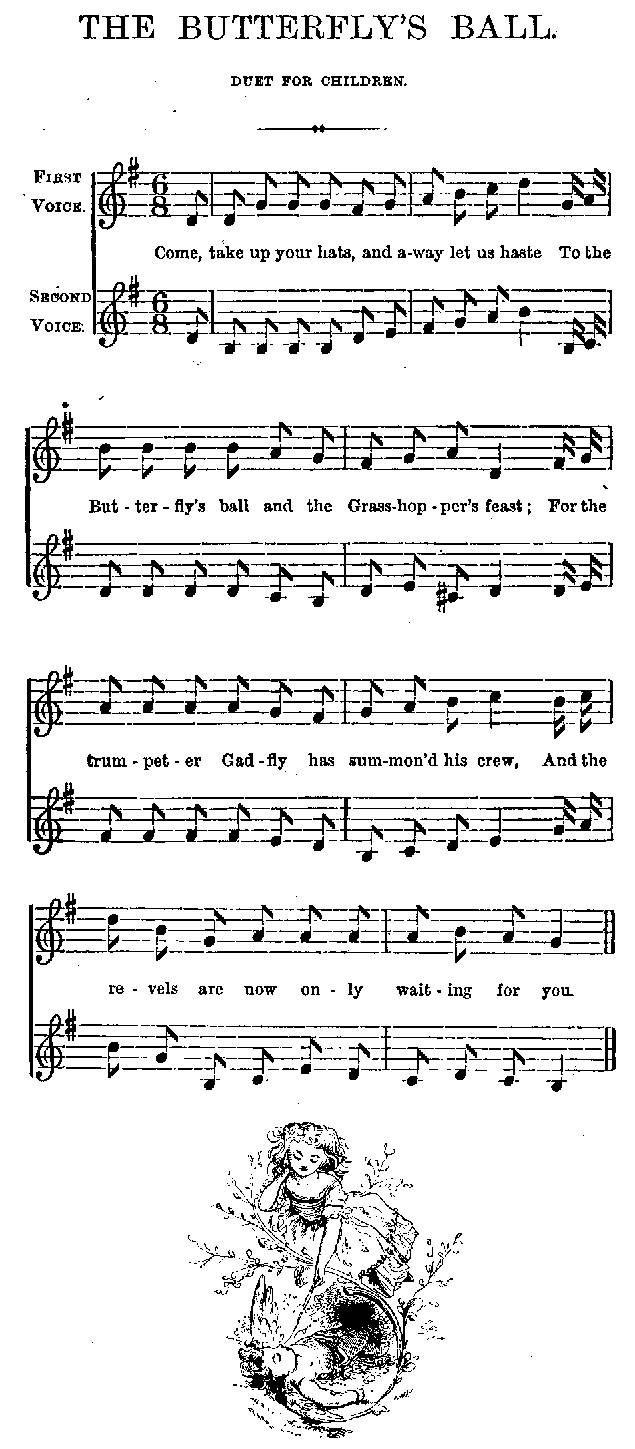
Come, take up your hats, and away let us haste
To the Butterfly’s ball and the Grasshopper’s feast;
For the trumpeter Gadfly has summoned his crew,
And the revels are now only waiting for you.
On the smooth-shaven grass by the side of the wood,
Beneath a broad oak that for ages has stood,
See the children of earth, and the tenants of air,
For an evening’s amusement together repair.
And there came the Beetle, so blind, and so black,
Who carried the Emmet, his friend, on his back;
And there came the Gnat, and the Dragonfly too,
And all their relations, green, orange, and blue.
And there came the Moth, with her plumage of down,
And the Hornet, with jacket of yellow and brown,
Who with him the Wasp, his companion, did bring—
They promised that evening to lay by their sting.
Then the sly little Dormouse peeped out of his hole,
And led to the feast his blind cousin the Mole;
And the Snail, with her horns peeping out from her shell,
Came fatigued with the distance, the length of an ell.
A Mushroom the table, and on it was spread
A Water-dock leaf, which their table-cloth made;
The viands were various, to each of their taste,
And the Bee brought the honey to sweeten the feast.
![]()
With steps more majestic the Snail did advance,
And he promised the gazers a minuet dance;
But they all laughed so loudly, he pulled in his head,
And went, in his own little chamber, to bed.
Then, as evening gave way to the shadows of night,
Their watchman, the Glow-worm, came out with his light.
So home let us hasten, while yet we can see,
For no watchman is waiting for you or for me.
Chapter Two.
The Butterfly’s Ball and the Grasshopper’s Feast.
Come, take up your hats, and away let us haste
To the Butterfly’s ball and the Grasshopper’s feast;
For the trumpeter Gadfly has summoned his crew,
And the revels are now only waiting for you.
On the smooth-shaven grass by the side of the wood,
Beneath a broad oak that for ages has stood,
See the children of earth, and the tenants of air,
For an evening’s amusement together repair.
It was very early one delightful morning in summer, when the trumpeter Gadfly sounded his horn, inviting all the insects in the forest to the Butterfly’s ball and the Grasshopper’s feast. The sun shone brightly, the air was mild and soft, and the scent of the wild flowers delicious, so that not one of the insects thought of staying at home. Butterflies, Beetles, Bees, Wasps, Snails, Grasshoppers, Ants, all put on their best coats and frocks, all, put on their sweetest smiles, and all hurried off, in little bands, to the ball, talking and laughing, and humming and buzzing, by the way, as if they were the happiest creatures in the wide world. Even the old Beetle, that had been run over by a cart-wheel and squeezed nearly to death, got out of bed when he heard what was going on, and limped along with the rest, though he had been confined to the house for six months before. One or two Butterflies, that were never known to go out except in the very finest weather,—and even then, carefully wrapped up,—determined to venture. They were long in making up their minds about it. One thought it looked a very little like rain; another feared that the light breeze might give them a cold. However, they put on a great many cloaks, and went.
From all directions they came, and assembled on a smooth, grassy spot, under an old oak-tree, where the revels were to take place. Some crawled slowly along the ground, some bounded quickly over hill and dale, some came running and tumbling, jumping and hitting against things in their haste; some came swiftly through the air, and alighted so suddenly as to tumble head over heels; others flew quietly to the scene and fluttered lightly about, admiring the happy company they were about to join.
And there came the Beetle, so blind, and so black,
Who carried the Emmet, his friend, on his back;
And there came the Gnat, and the Dragonfly too,
And all their relations, green, orange, and blue.
The Black Beetle was the first to make his appearance. He carried his dear friend the Emmet on his back, and a sad 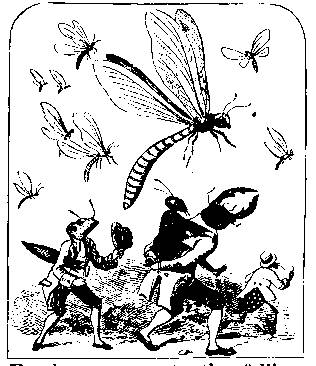 journey they had of it, to be sure! Being very blind, the Beetle was constantly falling over twigs, knocking his shins against the edges of leaves, and tumbling into ditches, so that the poor Emmet had many terrible falls, and once the great beetle fell on the top of him and crushed him a good deal. But it was very pleasant to see how cheerful they were under all this. On getting up after a fall, the beetle always laughed so boisterously that the tears ran down his cheeks, and his black sides nearly cracked; while the little Emmet said gaily, “Ah! my friend, accidents will happen! not hurt, I hope? Come, get along once more;” and then he jumped up on his friend’s back again, and away they went as merrily as ever.
A Gnat and a Dragonfly, with a great many of their relations, arrived about the same time with the Beetle. They looked quite charming in their brilliant dresses, the colours of which were chiefly green, orange, and blue. A large Blue-bottle Fly, with a very light waistcoat, and a hat stuck on one side of his head, said that the Dragonflies were 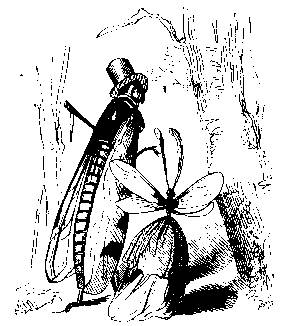 lovely, and that Miss Gnat was quite killing. This was an odd thing to say, but Mr Blue-bottle meant by it, that she was very beautiful. Indeed, it was said that he fell in love with Miss Gnat, for he danced with nobody else during the whole afternoon.
And there came the Moth, with her plumage of down,
And the Hornet, with jacket of yellow and brown,
Who with him the Wasp, his companion, did bring—
They promised that evening to lay by their sting.
The Moth was sound asleep when the Gadfly blew his trumpet. She had sat up too late the night before, and, owing to having indulged this bad habit, had overslept 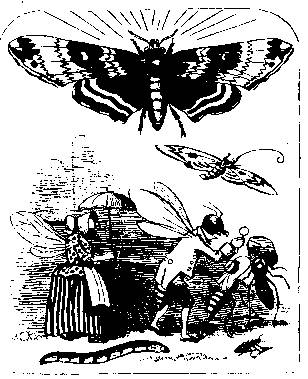 herself the following morning.
However, she tried by her activity to make up for lost 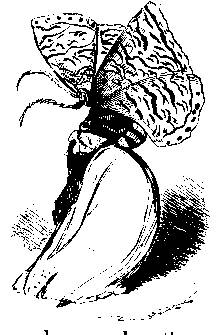 time; she saw the other insects hurrying past her house in crowds, so she threw on her clothes as fast as possible. The Moth was prettily dressed in a soft garment of down, and as she was a modest creature, every one loved her. On leaving home, she observed the Wasp and the Hornet passing. They were dressed in rich suits of brown and yellow. At sight of them she was a little frightened, and endeavoured to run back to her house until they should pass by; but they caught sight of her, and immediately gave chase, screaming out loudly, “Oh! dear Mrs Moth, pray don’t be alarmed. We have laid by our stings for to-day, and won’t hurt you.” They soon caught her, although she ran as fast as she could. So the Wasp and the Hornet each offered her an arm, and obliged her to walk between them while they danced along, shouting, and singing, and winking waggishly to the friends they passed on the road. The poor Moth blushed very much at being seen by all her friends in the company of two such wild creatures. A Caterpillar and a Long-legged Beetle, besides one or two other insects that chanced to be near, laughed very heartily on seeing what had happened. But the Moth soon recovered her spirits; and when they arrived at the oak-tree, she was walking along with a sprightly step, first talking to the Hornet and then chatting to the Wasp, as if they were her dearest friends.
Then the sly little Dormouse peeped out of his hole,
and led to the feast his blind cousin the Mole;
And the Snail, with her horns peeping out from her shell,
Came fatigued with the distance, the length of an ell.
“Come along, you lazy fellow,” cried the little 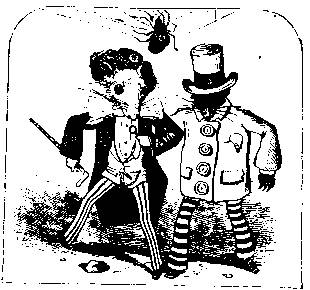 Dormouse, knocking with his ivory-headed cane at the door of a mole-hill.
“Ay, ay, cousin,” shouted the Mole, “I’ll be there in a minute.”
So the Dormouse stood impatiently tapping his boots till the Mole should be ready. The Dormouse was dressed in the height of fashion, and thought himself a rather handsome fellow. Some people said that he was conceited, and indeed a Spider that was near at hand plainly told him so; but, whether this was true or not, there is no doubt that he was a very kind little fellow, because he came to lead his poor blind cousin to the feast.
“What a time you have been, old boy,” he said, as the Mole appeared, dusting the earth off his coat and white hat.
The Mole answered that he had been very busy all morning making a new tunnel between his bed-room and drawing-room. He then took his friend’s arm, and away they went over the green meadows, where the cowslips and buttercups grew, making the grass look as if it were dotted all over with gold. Sometimes the two friends stopped by the way to rest under a buttercup, and sip a little morning dew; but seeing every one hastening past them, while they wasted their time, the Dormouse jumped up again, and cast a sly look at his blind friend as he asked him what he thought of the fine view.
“Don’t make jokes about my being blind,” said the Mole, pretending to be angry.
Just at that moment they both ran into a Spider’s web.
“Oh! how stupid of me,” cried the Dormouse; “I wasn’t looking before me at the time.”
“You might as well be without eyes, if you don’t use them,” said the Mole, as they cleared away the threads of the net, and, making a low bow to the Spider, went on their way.
Now, all this time the Snail had been slowly creeping over the stones and winding round the blades of grass and flowers that strewed her path to the place of meeting. But she was so long of getting there that the guests began to be impatient, and said that perhaps she was not coming at all. She lived under the next tree, and had only about four feet to walk, but she was so very slow 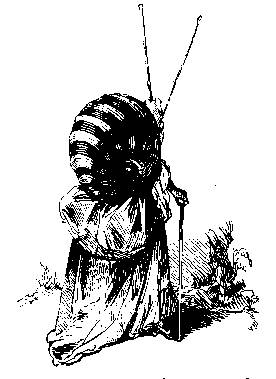 that she took a long, long time to it; and at last the Grasshopper whispered to the Butterfly that she should go and meet her. Away went the Butterfly on her gaudy wings, and, alighting by the Snail’s side, began to urge her to make haste. During the Butterfly’s absence, the Wasp, who was always making spiteful remarks, said that it was shameful in the Snail to keep them waiting; but the Humble-bee, who was walking up and down conversing with a Midge, turned round and said, “Remember, you Wasp, that you have not brought your sting with you to-day, so pray do not give way to your spiteful nature. The poor Snail has to carry her house on her back, so we should not be angry at her slowness.” Some of the other insects said that this was no excuse for the Snail, because she knew that she walked very slowly, and should therefore have set out sooner.
“Come, come,” cried a young Frog, jumping forward, “no fighting to-day, ladies and gentlemen. We have come here to be happy; and here comes the Snail at last.”
As he spoke, the Butterfly 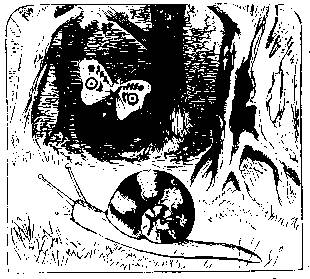 flew towards them, and the Snail crawled in, took off her bonnet, put on her spectacles, and sat down; while the waiters bustled about, placed stools for the guests, and brought in the repast.
A Mushroom the table, and on it was spread
A Water-dock leaf, which their table-cloth made;
The viands were various, to each of their taste,
And the Bee brought the honey to sweeten the feast.
It was, perhaps, the strangest dinner-party that ever was seen. There were such a multitude of odd creatures, of all shapes and sizes and colours; some of whom were by nature bitter enemies, and would have fought and killed each other had they met in the woods while taking a walk, but were quite civil and polite to one another, now that they met as guests in Mrs Butterfly’s bower. Indeed, 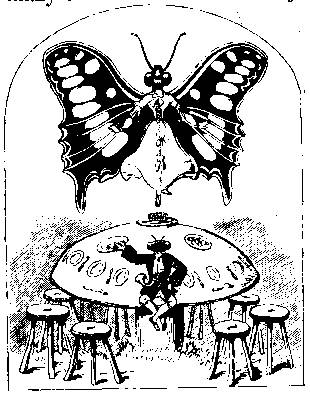 many of them wished that they could be such good friends at all times as they were then.
All the party had now arrived, and there was a great deal of talking, and buzzing, and humming, and jesting, as they sat round the table and feasted on the good things placed before them. The table was a mushroom, covered with a table-cloth of water-dock leaf, and on it were placed all the delicious dishes of the woods. The Dormouse brought a good deal of wheat, oats, and barley. The Squirrel brought a bagful of nuts. The Humble-bee brought a quantity of fine honey in the comb, which was 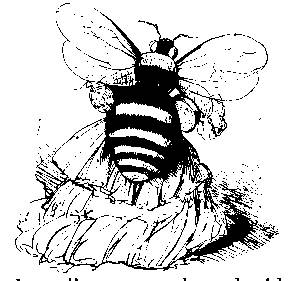 declared to be most excellent. In short, every one brought something or other; so that, when all was spread out beside the good things supplied by Mrs Butterfly and Mr Grasshopper, it seemed the grandest feast that ever was heard of. Such fun there was, to be sure! And such a multitude of voices talking all at once.
“My dear,” cried the Butterfly across the table to the Grasshopper, “I hope you are attending to your friends there. See that you give them enough to eat, and plenty of mountain-dew to drink.”
“Yes, yes, my love,” replied the Grasshopper as well as he could for laughing at the jokes of a bloated old Spider that sat beside him. Then the Grasshopper called to the 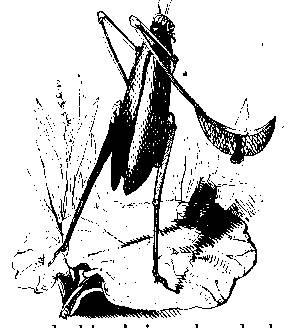 Butterfly to send him a slice of wheat; but, as the noise prevented his being heard, he jumped over the table at one bound, helped himself, and bounded back again. Two or three young Crickets and five or six Midges sat at a little side mushroom. They made more noise than all the grownup people put together; and the lady Butterfly looked round at them with a smile once or twice, quite delighted to see them so happy, and to hear their merry voices ringing through the woods.
With steps more majestic the Snail did advance,
And he promised the gazers a minuet dance;
But they all laughed so loudly, he pulled in his head,
And went, in his own little chamber, to bed.
After dinner the ball began, and it was the strangest ball that ever was seen. The trumpeter Gadfly and a number of his relations, besides several Grasshoppers and Bees, were the chief musicians. They wanted a bass very much at first, but the Bull-frog offered his services, although he confessed that he was accustomed to sing alone. Then the gentlemen drew on their gloves, flattened their wings, pulled up their collars, and coiled away their tails; while the ladies tightened their garters, ruffled 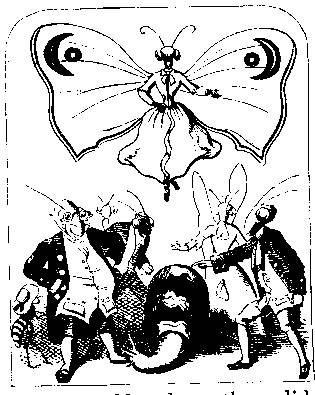 their feathers, and put out their feelers. Oh how they did dance! reels were nothing to it. The greatest difficulty was to keep the Grasshoppers in order. They became so excited that they sprang quite out of sight every moment, and so lost their partners, and ran against everybody in searching for them. Then the Bull-frog, who sang bass, got a little too much of the dew, and sang so loudly, that he quite drowned all the other players. So Mrs Butterfly put her claws in her ears, and running up to him, said, “Oh! dear Mr Bull-frog, pray do not sing quite so loudly.” The poor Bull-frog was almost weeping with joy at the merry scene before him, but he blushed very green on hearing this, and said he had forgotten what he was doing, but would try to be more careful. However, in five minutes more he was worse than ever, so they sent a few hundred bees to sing treble beside him, and try to keep him in order. In the middle of all this there was a sudden stop, and a Snail, stepping forward, offered to dance a minuet. This was received with such a roar of laughter that the poor snail, half frightened, half angry, drew in his horns and went to bed on the spot, and the dance was begun anew. By this time the Gnats and Midges, and some of the other flies, had left the ground and retired to enjoy a cool dance in the air. Two or three Spiders mounted up into the oak, and fastened threads to some of the branches, by which they dropped suddenly down among the dancers, and, seizing their partners round the waist, carried them screaming in among the leaves. So the fun and the noise became louder and louder. On the ground, under the bushes, among the branches of the trees, and in the air, the dancers bounded, skipped, laughed, sang, shouted, and flew in a way that had never been seen or heard of before. The merry old Bull-frog became quite absurd. He sang and roared like a lion; took up all the young insects in his arms and hugged them; tumbled over the other musicians, and, in short, did so many wild things that they were at length obliged to tie him to a paddock-stool, where they left him to enjoy himself.
Then, as evening gave way to the shadows of night,
Their watchman, the Glow-worm, came out with his light;
So home let us hasten, while yet we can see,
For no watchman is waiting for you or for me.
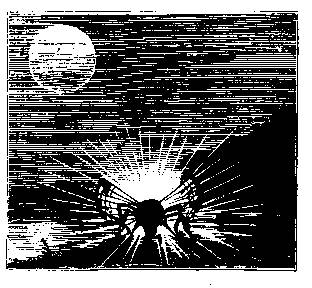
The sun went down at last, but still the dancers continued their sport under the old oak-tree, when suddenly a clear, beautiful light streamed across the turf. It was the Glow-worm’s light.
“How charming!” exclaimed the Butterfly. “It is such a sweet, subdued light.”
“Rather too much subdued,” growled the blundering Black Beetle, as he tripped over a twig and pulled his partner, a humble-bee, down with him; “couldn’t you shine a little brighter—eh?”
The Glow-worm shook his head. “Couldn’t give you another ray to save my life,” he said; “but if you send for a few of my friends, they will be happy to come and help me, no doubt.”
“A good suggestion,” said the Black Beetle, assisting his partner to rise.
“Oh, my poor frock,” cried the Humble-bee, gazing sadly at a long rent in the skirt.
“Never mind, let’s have at it again,” cried the Beetle, seizing her round the waist, and blundering on again in a furious gallop of his own invention.
“Whom shall I send for the Glow-worm’s relations?” muttered the Butterfly to herself.
“Send the Snail,” said a lively young Cricket, who had devoted himself to doing mischief during the whole evening.
“Peace, little goose,” replied the Butterfly, tapping the Cricket on the nose with her fan, and hastening towards the Grasshopper, who was still enthralled and convulsed by the bloated old Spider.
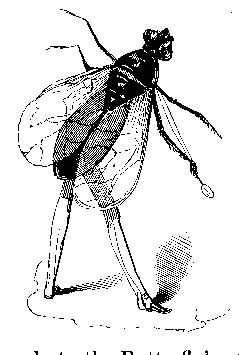
“Whom should we send, my dear!” said the Grasshopper, in reply to the Butterfly’s question; “the Fly footman, to be sure; and pray tell him to be smart about it, for I’ve been run down half-a-dozen times already by the dancers since the sun set. One lamp is too little for our ball-room. That blind Mole has run—ha! there he comes again. Look out!”
As he spoke, the Mole came bearing down towards them in a furious Portuguese waltz, with a horrified Dragonfly struggling in his arms.
The Grasshopper made a bound to get out of the way, but at that moment the lively young Cricket laid hold of his leg and held him fast. The consequence was that the Mole tumbled over him, fell on the top of the bloated Spider, and hit his head so violently on the breast of the Bull-frog that he stopped his noise immediately.
This sudden stoppage of the bass brought the other musicians to a stand, and as a matter of course stopped the dancing abruptly—with the exception of a deaf Squirrel, who had failed to find a partner, and who went on revolving slowly by himself as if nothing had happened.
“Dear me,” exclaimed everybody (except the Squirrel), “what has happened?”
“Oh, nothing worth mentioning,” said the Grasshopper, getting up with a limp. “You young rascal, what—why—there, take that.”
“Oh!” sobbed the young Cricket, pointing with a look of surprise at the Spider; “what a sight!”
He might well say so, for the bloated old Spider had been flattened out by the weight of the Mole to nearly twice her size, and was apparently quite dead. In great concern, the host and hostess ran to raise her.
“Are you hurt, dear?” asked the Butterfly, anxiously.
“Hurt!” exclaimed the Grasshopper, pushing her aside; “don’t you see she’s burst!”
“Oh me! I’m so sorry,” exclaimed the Mole, wringing his fore-paws.
At that moment there was a shout of eager expectation, for the Spider was seen to move. The Butterfly knelt at her side, and bending down, said tenderly—
“Tell me, dear, has he burst you?”
“N–no, n–not—qu–quite,” answered the Spider faintly; “I’m only f–flattened. Let some of you sq–squeeze m–my sides.”
Immediately a dozen of the young Crickets surrounded the old lady, and pressed her sides with all their might. This had the effect of raising her back a little, and enabling her to draw a good long breath, which speedily raised her up to her original size.
“There, I’m all right now,” she said in a cheerful voice; “I’m used to accidents of that sort, and they never leave any bad effects beyond a little stiffness of the lungs. Come, Grasshopper, I’ll finish that story. Get on with your dancing, good people.”
“Nobody inquires after me,” croaked the Bull-frog, rubbing his chest. “I had no idea a Mole’s head was so hard.”
“Have some mountain-dew,” said the Butterfly, gracefully handing him a blue-bell filled with the precious liquid. “It has been gathered on the Scottish hills by a native Bee, who has just arrived laden with heather-honey.”
The Bull-frog accepted the goblet, and drained it to the bottom.
“It is strong,” he said, coughing and smacking his lips.
“Oo ay,” observed the Scotch Bee; “it’s got the credit o’ bein’ a wee thing nippy.”
Under the influence of the dew the Bull-frog began to sing bass lustily. The other musicians chimed in. The dancers seized each other by waist and hand—or by tail and wing those that happened to have no waists or hands—and the ball was about to go on, when the Grasshopper shouted—
“Stop!”
“Your money or your life!” added the lively young Cricket.
“Silence, pert monkey!—Let us wait a few moments, my friends, for here come our lamps.”
As she spoke, a soft light was seen in the far distance gleaming upon the stems of the trees and steadily advancing.
“Your relations, Mr Glow-worm, I presume,” said the Butterfly in a sweet silvery voice. “It is so very kind of you to send for them, and so obliging in them to come. Really I cannot find words to express my gratitude.”
The countenance of the Glow-worm lighted up with pleasure at these words.
As the new-comers drew near, they appeared like a great galaxy of minute stars—as if a mass of the Milky-way had been cut off and hurled down to earth. There were several hundreds of them. As they approached, the whole forest lighted up; and when at last they descended upon the scene of the ball, and ranged themselves in a circle round the happy party, it seemed as if the sun himself had risen again to give them light—only the radiance was softer and more mysteriously tender than that of the sun!
Strong light has always an enlivening effect on creatures, whether human or otherwise. It cheered up the guests of Mrs Butterfly so much that they gave vent to an irresistible cheer; called for the music; and went on to dancing with more zest and energy than ever, insomuch that the attendant Glow-worms smiled to each other and nodded their heads.
Now it happened that every time the Glow-worms smiled their light increased. The lively young Cricket observed this, and began to wonder whether their light would increase still more if they were to laugh.
“I’ll try to find out,” said he, going up to a small Glow-worm—apparently a young one—and requesting her to step aside with him for a moment.
The little Glow-worm immediately became grave—in other words, dim—and went with him a little way into the woods.
“Now,” said the lively young Cricket, stopping, “can you laugh?”
“What?” said the little Glow-worm smiling, and, of course, lighting up.
“Yes, that’s it, smile away; but do it harder. I want you to laugh outright. Can’t you laugh?”
“Oh yes, when there is anything to laugh at.”
“Well, do it now.”
“But I can’t, please.”
“No; then I’ll make you.”
So saying, the young Cricket seized the little Glow-worm round the waist and tickled her.
Of course she laughed at first, and, to the Cricket’s delight, her face became wonderfully bright for a moment; but suddenly it became dim, for he hurt her, and she began to cry.
“You rascal!” exclaimed an angry voice, as the Grasshopper gave the Cricket a kick that sent him head over heels into the grass; “I felt sure you were after mischief, and I was right.”
“Oh, please, don’t kick him,” pleaded the little Glow-worm. “He didn’t mean to hurt me.”
“No matter. Get up, sir, and beg her pardon.”
The young Cricket got up at once and did what he was bid, for he really did not mean mischief, and was sorry he had hurt her; and little Miss Glow-worm rewarded him with a smile so radiant that it illuminated the spot where they stood quite brilliantly, and sparkled through her tears with rainbow hues.
“Now I would laugh to please you if I could,” said Miss Glow-worm, again smiling.
“Oh, never mind, my dear. I’ll make you and all your kindred laugh before the ball is over,” said the lively young Cricket, hurrying away, and going straight up to the Scotch Bee, who was clad in a tartan plaid and kilt.
“Bee,” said the Cricket, “can you dance the Highland Fling?”
“Ay, she can do that.”
“I could show you a better fling than the Highland one,” said the Cricket.
“Ho! could ye? ye must be verra cliver. Wull ye let her see’t?”
“Yes, if you’ll dance the Highland fling first? Will you do it if Mrs Butterfly asks you?”
The Scotch Bee good-naturedly agreed. Of course, the Cricket had no difficulty in persuading the hostess to ask him. The musicians could not play a reel; but this mattered not, for the Bee could hum to himself. Great was the delight and surprise of the company when they beheld the Scotch Bee twirling his legs, snapping his fingers, and humming the reel of Tulloch, while the tartans fluttered round him like shreds of a shattered rainbow.
The dance waxed more and more furious, and the plaudits of the company grew louder, when, suddenly, the lively young Cricket ran in between the Bee’s legs, tripped him up, and sent him sprawling on the grass. A wild shout of laughter burst from the company—Glow-worms included—and the ball-room brightened up for a few moments as if it had been set on fire!
“That’s the fling I spoke of,” cried the Cricket, leaping up and running away.
The Scotch Bee sprang up, drew his dirk, and gave chase, but Mr Grasshopper caught him by the arm and dragged him off.
“Ho! friends—supper—supper! This way. Don’t sheathe your dirk. I have a haggis ready for you to sheathe it in. Come along; give your arm to that bloated old Spider there. She’ll keep you in spirits.”
The Bee was mollified. He gave his arm to the Spider; then all the company went off to sup in a neighbouring glade. Shall we describe the supper? We think not. It was beyond description delightful. Just as it was finished the moon rose from behind a cloud, so the company knew that it was time to go home.
Before going away, they all assembled at the foot of the oak, and shook claws with Lady Butterfly and Mr Grasshopper, saying that they were charmed with the delightful evening they had spent, and that they hoped to be soon invited again.
In a few minutes they were all gone. The sounds of their laughing voices, as they returned home, died gradually away, and the shadows of night spread over the quiet forest and the happy little creatures that slumbered there.